Ocena krvavitev
Dobrodošli v naši oceni krvavitev
Odkriti, ali preveč krvavite, ni vedno enostavno. Ta test je bil razvit, da pomaga vam in vašemu zdravniku odkriti, ali je vaša krvavitev normalna ali ne.
Vprašalnik temelji na znanstveno validiranem orodju, prilagojenem s strani Prof. Corralesa in Prof. Erik Berntorpa1,2.
ODGOVORNOST
PROSIMO UPOŠTEVAJTE: Ta vprašalnik temelji na znanstveno validiranem orodju, prilagojenem s strani Prof. Corralesa in Prof. Erik Berntorpa1,2 . Lahko se uporablja za ugotovitev, če je lahko prisotna motnja strjevanja krvi. Namenjen je samo za informativne namene in kot podpora za pogovor s kvalificiranim licenciranim zdravstvenim delavcem. Na noben način ni namenjen kot nadomestilo za profesionalni zdravniški nasvet in presojo. Če imate vprašanja ali skrbi glede rezultata tega testa, se morate posvetovati s svojim zdravnikom ali zdravstvenim delavcem.
OSEBNI PODATKI: Preden rešite ta test, želimo, da se zavedate naslednjih informacij glede vaše zasebnosti:
- Odgovori, ki jih podate v tem testu, se uporabijo za izračun točk tveganja za von Willebrandovo bolezen (VWD).
- Podatki, ki jih vnesete v ta obrazec, bodo shranjeni in uporabljeni s strani Octapharma AG samo za statistične namene glede pogostnosti VWD, in bodo zadevali samo takšne podatke, kot so ustrezni in primerni za ta namen.
- V nobenem trenutku ne boste zaprošeni, da vnesete kakršne koli podatke, ki bi izdali vašo osebno identiteto.
- Uporabniški ID, ki se vnese pod "ponovni obiskovalci" samo omogoča, da je druga ocena, ki jo vnesete, neposredno povezana s prvo oceno, ki je bila vnešena predhodno. Struktura obrazca druge ocene je identična tiste iz prve ocene. V nobenem trenutku uporabnik ne bo osebno identificiran.
Za več informacij se prosimo posvetujte izjava o zasebnosti podatkov.
1. A quantitative analysis of bleeding symptoms in type 1 von Willebrand disease: results from a multicenter European study (MCMDM-1 VWD). Tosetto A, Rodeghiero F, Castaman G, Goodeve A, Federici AB, Batlle J, et al. J Thromb Haemost. 2006; 4: 766-73. 2. A need to increase von Willebrand disease awareness: vwdtest.com/si - A global initiative to help address this gap. Corrales-Medina FF, Federici AB, Srivastava A, Dougall A, Millar CM, et al. Blood Rev. 2023; 58: 101018.
Imate člane svoje ožje družine*, ki so jim diagnosticirali motnjo strjevanja krvi?
*Starši, sorojenci ali otroci
Korak {{questionIndex+1}}/{{questions.length}}
Vaš rezultat krvavitev je nenormalen.
To kaže, da imate morda motnjo strjevanja krvi.
Vaš rezultat
{{ nbPointsAnswers > 0 ? nbPointsAnswers : 0 }}
Normalno območje: 0-3
Hvala, ker ste rešili test. Priporočamo, da si shranite obvestilo o rezultatu in se o tem pogovorite z zdravnikom. Obstaja velika možnost, da je vaša krvavitev obvladljiva in zdravnik vam bo pomagal najti pravo zdravljenje.
Se sprašujete, ali tudi drugi družinski člani preveč krvavijo? Prosite jih, naj rešijo test.
Koristni viriVaš rezultat krvavitev je normalen.
Če boste v prihodnosti krvaveli več, prosimo ponovite test. Če ste negotovi glede vaših krvavitev, se prosimo posvetujte z zdravnikom.
Vaš rezultat
{{ nbPointsAnswers > 0 ? nbPointsAnswers : 0 }}
Normalno območje: 0-3
Ta test kaže, da nimate motnje strjevanja krvi, vendar to ni nadomestilo za popolno oceno s strani izkušenega zdravstvenega delavca.
User ID: {{assessmentId}}
Your bleeding score indicates that you may have a bleeding disorder. However, this test is not a replacement for a complete assessment by a trained healthcare professional, and further information would be needed to make a proper diagnosis.
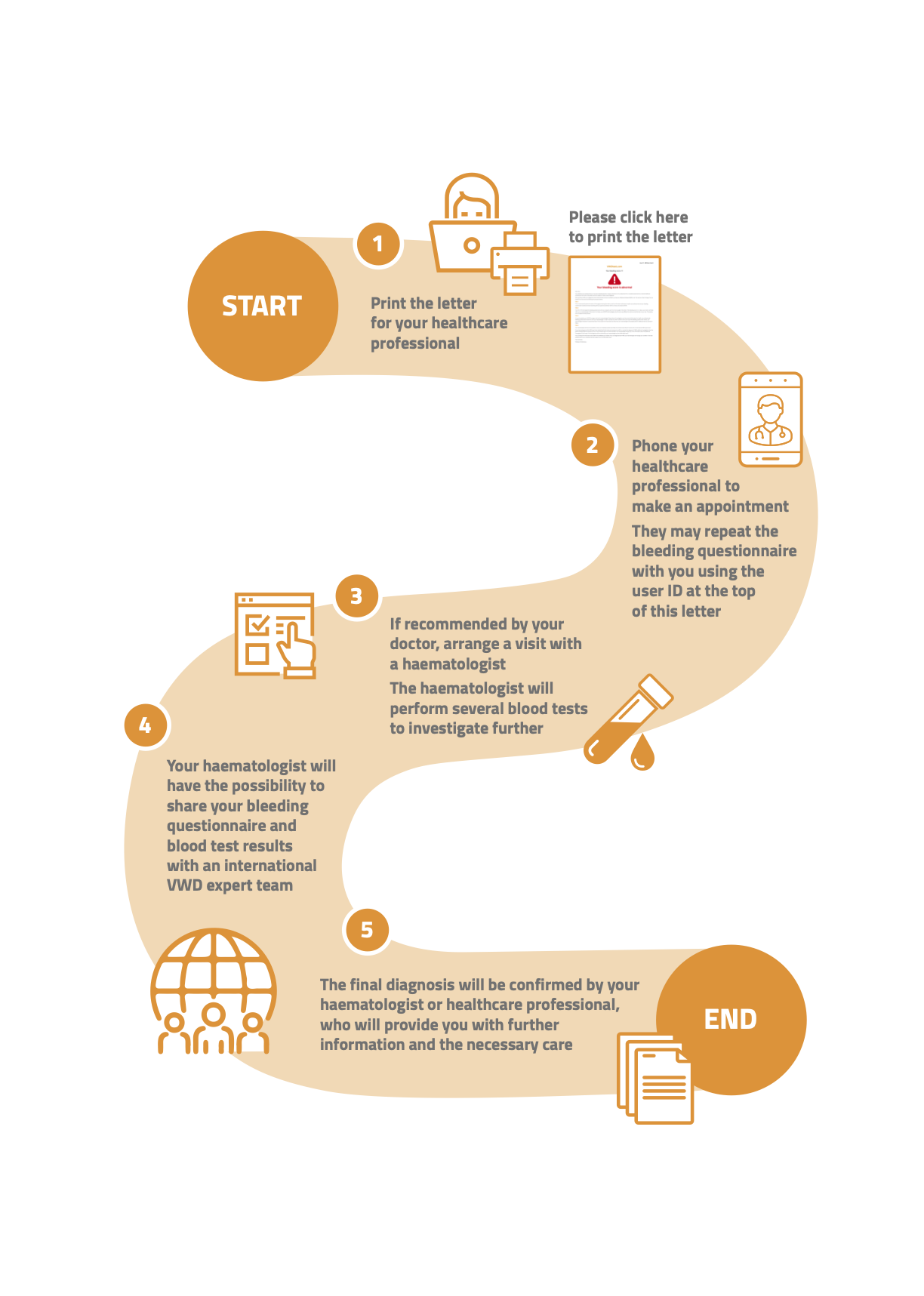
Please follow the steps below to ensure a full diagnosis.
Centers recommended for following up on the results with a von Willebrand specialist near your current location.
This letter is addressed to Health Care Professionals 999
Dear Colleagues,
My name is Erik Berntorp and I am a Professor in Haematology and Coagulation Disorders at Lund University in Sweden. As you may be aware, von Willebrand disease (VWD) is the most common bleeding disorder (affecting up to 1% of the world’s population) yet is still highly underdiagnosed. Together with other colleagues we have developed the VWDtest.com online platform, with the aim of improving the diagnosis of VWD. At the VWDtest.com website, users can complete a simple five-minute questionnaire to evaluate whether they may have a bleeding disorder or not.
In this case, the questionnaire has indicated that the user may have a bleeding disorder. We are here to help you identifying whether this person is affected by VWD. The support we provide includes advice on VWD diagnosis from world-leading experts as well as blood and plasma sample analysis in state of the art laboratories. These services are free of charge if the procedures below are strictly followed.
I hope you will benefit from the support of the VWDtest.com team and help us facilitating accurate VWD diagnosis.
How to proceed
- Following an abnormal bleeding test score, the individual has been asked to repeat the online bleeding questionnaire with their General Practitioner/Primary Care physician (GP/PCP). If this is you, please jump to the section “For GP/PCP” below.
- If the bleeding test results were similar when the test was repeated, the GP/PCP has been asked to refer the patient to a haematologist. If this is you, please jump to the section “For the haematologist” below.
For the GP/PCP
Please repeat the bleeding questionnaire together with your patient using the user ID (on the top right on the bleeding questionnaire results). Please don’t share more patient’s personal data than necessary for this purpose and please always adhere to the applicable data protection laws and regulations.
In case the bleeding score of your patient is 4 or above, please refer them to a haematologist. Please ensure that the haematologist is provided with the bleeding questionnaire results and informed about the purpose of this investigation.
In case the score is 3 or below, the patient does not need further investigation.
For the haematologist
Before contacting the VWD expert team, please execute the following blood tests:
- Complete blood count
- Activated partial thromboplastin time (APTT)
- Prothrombin time (PT)
- Fibrinogen
- Platelet function assay (PFA)
Abnormalities in the above mentioned laboratory tests, together with a clinical anamnestic patient data could give a sign for VWD. You have the possibility to contact and discuss your patient condition with our VWD expert team.
After having performed these blood tests, please contact the VWD expert team:
If you have any clinical questions about VWD, please send an email to Dr. Fernando Corrales (ffc5@med.miami.edu) if you are located in the continent of America and to Prof. Erik Berntorp (erik.berntorp@med.lu.se) if you are located anywhere else in the world stating your name, affiliation contact details and question(s). Please share the results from the bleeding questionnaire and blood tests.
Please don’t share more patient’s personal data than necessary for this purpose and please always adhere to the applicable data protection laws and regulations.
For a free sample analysis service (this service is not available in the United States) helping you to diagnose VWD, please send an email to Dr. Anna Pavlova (Anna.Pavlova@ukbonn.de) stating your name, affiliation contact details and question(s). Please share the results from the bleeding questionnaire and blood tests.
Again, please don’t share more patient’s personal data than necessary for this purpose and please always adhere to the applicable data protection laws and regulations.
Your email will be processed by the respective VWD expert, who will reply to you shortly. If you and the VWD expert team decide that further diagnostic tests are necessary, you may be asked to submit blood and plasma samples from your patient for analysis (detailed information on how to submit the samples will be provided to you). The submitted samples will undergo several tests, which may include: von Willebrand factor (VWF) antigen and activity levels, FVIII activity, VWF multimer analysis, and FVIII-binding assays. These tests will confirm or exclude whether the patient has VWD. In addition, if a VWD diagnosis is made, next-generation sequencing will be carried out to look for possible causative variations in the VWF gene.
This sample analysis service is free of charge, but only available upon explicit written request by a member of the VWD expert team. Any unsolicited sample submissions will be disregarded.
Support and advice on diagnosis and management options will continue to be available from the VWD expert team, free of charge, after the sample analysis results have been provided.
Yours sincerely,
Professor Erik Berntorp

Ta dopis je naslovljen na zdravstvene delavce.
Dragi kolegi,
Moje ime je Erik Berntorp in sem profesor na Oddelku za hematologijo in bolezni strjevanja krvi na Univerzi v Lundu na Švedskem. Kot verjetno veste, je von Willebrandova bolezen (VWD) najpogostejša motnja strjevanja krvi (prizadene do 1% svetovne populacije), ki je še vedno mnogo preredko diagnosticirana. Skupaj z drugimi kolegi smo razvili spletno platformo vwdtest.com/si/us, s ciljem izboljšati diagnozo VWD. Na spletni strani vwdtest.com/si/us lahko uporabniki izpolnijo enostaven pet-minutni vprašalnik za oceno, če imajo morda lahko bolezen strjevanja krvi ali ne.
V tem primeru je vprašalnik nakazal, da bi uporabnik morda lahko imel VWD. Tukaj smo, da vam pomagamo identificirati, ali ima ta oseba VWD. Podpora, ki jo nudimo, vključuje nasvet glede diagnoze VWE s strani vodilnih svetovnih strokovnjakov, kot tudi analizo krvi in vzorcev v državnih laboratorijih v nekaterih državah. V teh državah so te storitve brezplačne, če se strogo sledi postopku.
Upam, da boste imeli vi in vaši bolniki korist od podpore s strani ekipe na vwdtest.com/si/us in nam pomagali izboljšati točno diagnozo VWD.
Kako postopati
– Po nenormalnem rezultatu testa krvavitev je bil posameznik zaprošen, naj ponovi spletni vprašalnik o krvavitvah skupaj s svojim splošnim zdravnikom. Če ste to vi, prosimo pojdite na poglavje “Za splošne zdravnike” spodaj.
– Če so bili rezultati testa podobni, ko je bil test ponovljen, je bil splošni zdravnik naprošen, naj napoti bolnika k hematologu. Če ste to vi, prosimo pojdite na poglavje “Za hematologe” spodaj.
Za splošne zdravnike
Prosimo ponovite vprašalnik o krvavitvah skupaj z vašim bolnikom z uporabo uporabniškega ID (zgoraj desno na rezultatu vprašalnika o krvavitvah). Prosim ne delite več bolnikovih osebnih podatkov, kot je potrebno za ta namen, in prosimo vedno upoštevajte uporabne podatke zakonov in predpisov o varstvu podatkov.
V primeru, da je rezultat testa krvavitev pri vašem bolniku 4 ali več, ga prosimo napotite k hematologu. Prosimo zagotovite, da bo hematolog prejel rezultate vprašalnika o krvavitvah in da bo obveščen o namenu te preiskave.
Za hematologa
Preden kontaktirate ekipo strokovnjakov za VWD, prosimo izvedite naslednje krvne preiskave:
- Popolno krvno sliko
- Aktivirani delni tromboplastinski čas (APTT)
- Protrombinski čas (PT)
- Fibrinogen
- Test delovanja trombocitov (PFA)
Abnormalnosti pri zgoraj omenjenih laboratorijskih preskavah, skupaj s klinično anamnezo bolnika, bi lahko kazali na VWD. O stanju bolnika se lahko posvetujete z našo ekipo strokovnjakov za VWD.
Po izvedbi teh krvnih testov in če imate kakršna koli klinična vprašanja o VWD, prosimo pošljite elektronsko pošto Dr. Fernando Corralesu (ffc5@med.miami.edu), če ste na ameriškem kontinentu, ali Prof. Erik Berntorpu (erik.berntorp@med.lu.se), če ste kjer koli drugje na svetu, z navedbo vašega imena, kontaktnih podatkov ustanove in vprašanj(a). Prosimo pošljite tudi rezultate vprašalnika o krvavitvah in krvnih preiskav.
Prosimo ne delite več bolnikovih osebnih podatkov, kot je potrebno za ta namen, in prosimo vedno upoštevajte uporabne podatke zakonov in predpisov o varstvu podatkov.
V nekaterih državah nudimo brezplačno storitev analize vzrocev, ki vam pomaga diagnosticirati VWD. Če bi radi prejeli nadaljnje informacije o teh storitvah in za povpraševanje, če je to na voljo v vaši državi, prosimo pošljite elektronsko pošto na VWDtest_service@octapharma.com z navedbo vašega imena, kontaktnih podatkov ustanove in vprašanj(a). Vašo elektronsko pošto bo obravnaval član ekipe vwdtest.com/si/us, ki vam bo odgovoril v kratkem času.
Če je ta storitev na voljo v vaši državi, prosimo pošljite rezultate vprašalnika o krvavitvah in krvnih preiskav. Ponovno prosimo, ne delite več bolnikovih osebnih podatkov, kot je potrebno za ta namen, in prosimo vedno upoštevajte uporabne podatke zakonov in predpisov o varstvu podatkov.
Če se vi in ekipa strokovnjakov za VWD odločite, da so potrebne nadaljnje diagnostične preiskave, boste zaprošeni, da predložite vzorce krvi in plazme vašega bolnika za analizo (prejeli boste podrobne informacije o tem, kako predložiti vzorce). Na poslanih vzorcih bo narejeno več preiskav, ki lahko vključujejo: antigen von Willebrandovega faktorja (VWF) in ravni aktivnosti, aktivnost FVIII, multimerna analiza VWF in teste vezave FVIII. Te preiskave bodo potrdile ali izključile, ali ima bolnik VWD. Poleg tega bo, če bo narejena diagnoza VWD, izvedeno sekvenciranje naslednje generacije, da se poišče možne vzročne variacije VWF gena.
Če je ta storitev na voljo v vaši državi, bo izvedena brezplačno, vendar samo po potrditvi ekipe vwdtest.com/si/us team in skladno z obstoječimi postopki. Vsi nenaročeni vzroci bodo zavrženi.
Podpora in nasvet glede diagnoze in možnosti zdravljenja s strani ekipe strokovnjakov za VWD bodo še naprej na voljo brezplačno.
S spoštovanjem,
Profesor Erik Berntorp in
Fernando Corrales-Medina
{{assessmentId}}
{{userInformation.email}}
{{userInformation.sex}}
{{userInformation.age}}
{{userInformation.familyHistory}}
Država: {{userInformation.country}} - Regija: {{userInformation.region}}
{{question.questionTitle}}
{{question.selectedAnswer.title}}
Obdelava osebnih podatkov s strani Octapharma AG
Naslednji osebni podatki bodo poslani Octapharma AG z namenom storitve analize vzorcev in torej samo za koordinacijo pošiljanja vzorcev: Ime in ustanova ter elektronska pošta hematologa, ki zaproša za storitev analize vzorcev.
Samo če je potrebno zaradi zakonov/kodeksa ali če je potrebno zaradi namena ustrezne storitve, se ta informacija deli z drugimi pravnimi osebami znotraj Octapharme.
Prenos na družbe skupine temelji na isti pravni podlagi kot samo procesiranje. Da bi zagotovili varstvo osebnih podatkov, je Octapharma podpisala Sporazum o prenosu podatkov med podjetji s svojimi hčerinskimi družbami.
Poleg tega lahko Octapharma vključi izvajalce storitev za obdelavo osebnih podatkov v imenu Octapharme. Taki izvajalci storitev lahko samo obdelujejo osebne podatke skladno s hitrimi navodili Octapharme in podatkov ne smejo uporabiti za lastne namene.
Imate pravico zahtevati, da ste obveščeni o osebnih podatkih, ki so v obdelavi/shranjeni v Octapharmi.
Imate pravico zahtevati kakršne koli popravke ali modifikacije osebnih podatkov, ki so nepravilni.
Za fizične osebe v EU/EEA/CH: Poleg tega ima oseba, ki ima kakršne koli težave glede obdelave osebnih podatkov s strani Octapharme, pravico vložiti pritožbo na pristojni organ za varstvo podatkov.
Poleg zgoraj omenjenih pravic ima oseba tudi pravico nasprotovati določeni obdelavi osebnih podatkov, pravico zahtevato omejitev obdelave osebnih podatkov in pravico do prenosljivosti podatkov. Pravica do prenosljivosti krije take osebne podatke, ki jih Octapharma obdeluje v elektronski obliki.
Octapharma bo hranila informacije za tako časovno obdobje, kot je potrebno za zagotovitev, da Octapharma zadosti pravnim in drugim obvezam, ali za zagotovitev, da Octapharma dokazuje, brani ali uveljavlja pravne zahtevke. Ko osebni podatki za te namene niso več potrebni, bodo varno izbrisani, z upoštevanjem časa hrambe po lokalnih zakonih. Vprašanja in zahtevke glede vaših osebnih podatkov prosimo pošljite na elektronsko pošto na: dataprivacy@octapharma.com.
Assist Prof. Nidal Karim Maroof Al-Rahal
Consultant Pediatrician in Research and Management Unit of Hemophilia & Rare Inherited Bleeding
Disorders
National Center of Hematology, Mustansiriyah University
Baghdad, Iraq
Ta dopis je naslovljen na zdravstvene delavce.
Dragi kolegi,
Moje ime je Erik Berntorp in sem profesor na Oddelku za hematologijo in bolezni strjevanja krvi na Univerzi v Lundu na Švedskem. Kot verjetno veste, je von Willebrandova bolezen (VWD) najpogostejša motnja strjevanja krvi (prizadene do 1% svetovne populacije), ki je še vedno mnogo preredko diagnosticirana. Skupaj z drugimi kolegi smo razvili spletno platformo vwdtest.com/si/us, s ciljem izboljšati diagnozo VWD. Na spletni strani vwdtest.com/si/us lahko uporabniki izpolnijo enostaven pet-minutni vprašalnik za oceno, če imajo morda lahko bolezen strjevanja krvi ali ne.
V tem primeru je vprašalnik nakazal, da bi uporabnik morda lahko imel VWD. Tukaj smo, da vam pomagamo identificirati, ali ima ta oseba VWD. Podpora, ki jo nudimo, vključuje nasvet glede diagnoze VWE s strani vodilnih svetovnih strokovnjakov, kot tudi analizo krvi in vzorcev v državnih laboratorijih v nekaterih državah. V teh državah so te storitve brezplačne, če se strogo sledi postopku.
Upam, da boste imeli vi in vaši bolniki korist od podpore s strani ekipe na vwdtest.com/si/us in nam pomagali izboljšati točno diagnozo VWD.
Kako postopati
– Po nenormalnem rezultatu testa krvavitev je bil posameznik zaprošen, naj ponovi spletni vprašalnik o krvavitvah skupaj s svojim splošnim zdravnikom. Če ste to vi, prosimo pojdite na poglavje “Za splošne zdravnike” spodaj.
– Če so bili rezultati testa podobni, ko je bil test ponovljen, je bil splošni zdravnik naprošen, naj napoti bolnika k hematologu. Če ste to vi, prosimo pojdite na poglavje “Za hematologe” spodaj.
Za splošne zdravnike
Prosimo ponovite vprašalnik o krvavitvah skupaj z vašim bolnikom z uporabo uporabniškega ID (zgoraj desno na rezultatu vprašalnika o krvavitvah). Prosim ne delite več bolnikovih osebnih podatkov, kot je potrebno za ta namen, in prosimo vedno upoštevajte uporabne podatke zakonov in predpisov o varstvu podatkov.
V primeru, da je rezultat testa krvavitev pri vašem bolniku 4 ali več, ga prosimo napotite k hematologu. Prosimo zagotovite, da bo hematolog prejel rezultate vprašalnika o krvavitvah in da bo obveščen o namenu te preiskave.
Za hematologa
Preden kontaktirate ekipo strokovnjakov za VWD, prosimo izvedite naslednje krvne preiskave:
- Popolno krvno sliko
- Aktivirani delni tromboplastinski čas (APTT)
- Protrombinski čas (PT)
- Fibrinogen
- Test delovanja trombocitov (PFA)
Abnormalnosti pri zgoraj omenjenih laboratorijskih preskavah, skupaj s klinično anamnezo bolnika, bi lahko kazali na VWD. O stanju bolnika se lahko posvetujete z našo ekipo strokovnjakov za VWD.
Po izvedbi teh krvnih testov in če imate kakršna koli klinična vprašanja o VWD, prosimo pošljite elektronsko pošto Dr. Fernando Corralesu (ffc5@med.miami.edu), če ste na ameriškem kontinentu, ali Prof. Erik Berntorpu (erik.berntorp@med.lu.se), če ste kjer koli drugje na svetu, z navedbo vašega imena, kontaktnih podatkov ustanove in vprašanj(a). Prosimo pošljite tudi rezultate vprašalnika o krvavitvah in krvnih preiskav.
Prosimo ne delite več bolnikovih osebnih podatkov, kot je potrebno za ta namen, in prosimo vedno upoštevajte uporabne podatke zakonov in predpisov o varstvu podatkov.
V nekaterih državah nudimo brezplačno storitev analize vzrocev, ki vam pomaga diagnosticirati VWD. Če bi radi prejeli nadaljnje informacije o teh storitvah in za povpraševanje, če je to na voljo v vaši državi, prosimo pošljite elektronsko pošto na VWDtest_service@octapharma.com z navedbo vašega imena, kontaktnih podatkov ustanove in vprašanj(a). Vašo elektronsko pošto bo obravnaval član ekipe vwdtest.com/si/us, ki vam bo odgovoril v kratkem času.
Če je ta storitev na voljo v vaši državi, prosimo pošljite rezultate vprašalnika o krvavitvah in krvnih preiskav. Ponovno prosimo, ne delite več bolnikovih osebnih podatkov, kot je potrebno za ta namen, in prosimo vedno upoštevajte uporabne podatke zakonov in predpisov o varstvu podatkov.
Če se vi in ekipa strokovnjakov za VWD odločite, da so potrebne nadaljnje diagnostične preiskave, boste zaprošeni, da predložite vzorce krvi in plazme vašega bolnika za analizo (prejeli boste podrobne informacije o tem, kako predložiti vzorce). Na poslanih vzorcih bo narejeno več preiskav, ki lahko vključujejo: antigen von Willebrandovega faktorja (VWF) in ravni aktivnosti, aktivnost FVIII, multimerna analiza VWF in teste vezave FVIII. Te preiskave bodo potrdile ali izključile, ali ima bolnik VWD. Poleg tega bo, če bo narejena diagnoza VWD, izvedeno sekvenciranje naslednje generacije, da se poišče možne vzročne variacije VWF gena.
Če je ta storitev na voljo v vaši državi, bo izvedena brezplačno, vendar samo po potrditvi ekipe vwdtest.com/si/us team in skladno z obstoječimi postopki. Vsi nenaročeni vzroci bodo zavrženi.
Podpora in nasvet glede diagnoze in možnosti zdravljenja s strani ekipe strokovnjakov za VWD bodo še naprej na voljo brezplačno.
S spoštovanjem,
Profesor Erik Berntorp
Vaš rezultat krvavitev: {{nbPointsAnswers}}

Vaš rezultat krvavitev je nenormalen

Vaš rezultat krvavitev je normalen
{{testDate}}
{{assessmentId}}
{{userInformation.sex}}
{{userInformation.age}}
{{userInformation.familyHistory}}
Država: {{userInformation.country}} - Regija: {{userInformation.region}}
{{question.questionTitle}}
{{question.selectedAnswer.title}}
Vaš rezultat krvavitev:Your bleeding score: {{previousAssessmentData.score}}
Vaš rezultat krvavitev je nenormalen
Vaš rezultat krvavitev je normalen
{{previousAssessmentDate}}
{{previousAssessmentId}}
{{previousAssessmentData.sex}}
{{previousAssessmentData.age}}
{{previousAssessmentData.family_history}}
Država: {{previousAssessmentData.country}} - Regija: {{previousAssessmentData.region}}
{{answer.question_title}}
{{answer.answer_title}}
Obdelava osebnih podatkov s strani Octapharma AG
Naslednji osebni podatki bodo poslani Octapharma AG z namenom storitve analize vzorcev in torej samo za koordinacijo pošiljanja vzorcev: Ime in ustanova ter elektronska pošta hematologa, ki zaproša za storitev analize vzorcev.
Samo če je potrebno zaradi zakonov/kodeksa ali če je potrebno zaradi namena ustrezne storitve, se ta informacija deli z drugimi pravnimi osebami znotraj Octapharme.
Prenos na družbe skupine temelji na isti pravni podlagi kot samo procesiranje. Da bi zagotovili varstvo osebnih podatkov, je Octapharma podpisala Sporazum o prenosu podatkov med podjetji s svojimi hčerinskimi družbami.
Poleg tega lahko Octapharma vključi izvajalce storitev za obdelavo osebnih podatkov v imenu Octapharme. Taki izvajalci storitev lahko samo obdelujejo osebne podatke skladno s hitrimi navodili Octapharme in podatkov ne smejo uporabiti za lastne namene.
Imate pravico zahtevati, da ste obveščeni o osebnih podatkih, ki so v obdelavi/shranjeni v Octapharmi.
Imate pravico zahtevati kakršne koli popravke ali modifikacije osebnih podatkov, ki so nepravilni.
Za fizične osebe v EU/EEA/CH: Poleg tega ima oseba, ki ima kakršne koli težave glede obdelave osebnih podatkov s strani Octapharme, pravico vložiti pritožbo na pristojni organ za varstvo podatkov.
Poleg zgoraj omenjenih pravic ima oseba tudi pravico nasprotovati določeni obdelavi osebnih podatkov, pravico zahtevato omejitev obdelave osebnih podatkov in pravico do prenosljivosti podatkov. Pravica do prenosljivosti krije take osebne podatke, ki jih Octapharma obdeluje v elektronski obliki.
Octapharma bo hranila informacije za tako časovno obdobje, kot je potrebno za zagotovitev, da Octapharma zadosti pravnim in drugim obvezam, ali za zagotovitev, da Octapharma dokazuje, brani ali uveljavlja pravne zahtevke. Ko osebni podatki za te namene niso več potrebni, bodo varno izbrisani, z upoštevanjem časa hrambe po lokalnih zakonih. Vprašanja in zahtevke glede vaših osebnih podatkov prosimo pošljite na elektronsko pošto na: dataprivacy@octapharma.com.
Assist Prof. Nidal Karim Maroof Al-Rahal
Consultant Pediatrician in Research and Management Unit of Hemophilia & Rare Inherited Bleeding
Disorders
National Center of Hematology, Mustansiriyah University
Baghdad, Iraq